
Kubernetes Security in 2026: Modern Threats and How to Defend Against Them

By Ananta Cloud — Autonomous Cloud. Infinite Scale.

Kubernetes has evolved dramatically in the past few years, but so have the adversaries who target it.2026 marks the beginning of a new security era where attackers no longer behave like noisy, opportunistic intruders.
They behave like adaptive predators, powered by automation and AI, capable of breaching clusters faster than human defenders can react.
Below is a deep dive into the 10 most critical Kubernetes threats of 2026, how attackers exploit them, and how organizations can defend themselves in a world where infrastructure moves at machine speed.
1. AI-Powered Attacks: Threats That Think Faster Than You React
In 2026, adversaries use AI not as an accessory, but as the core engine of their attack chains.
Modern attacker models can now:
Scan K8s clusters for misconfigurations at machine speed Detecting open dashboards, insecure ports, misconfigured services, and RBAC weaknesses in seconds.
Chain privilege-escalation opportunities automatically AI systems map all lateral movement paths, identifying the shortest route to admin-level privileges.
Generate polymorphic container malware Code that mutates itself to evade static and behavioral detection tools.
Predict workload scale patterns Exploiting autoscaling windows when containers spawn rapidly — a perfect time to slip in malicious replicas.
These threats don’t "break in." They flow through your system using intelligence that evolves during the attack.

How to Defend
Deploy AI-assisted anomaly detection Tools must baseline normal behavior and detect deviations instantly, far faster than human monitoring.
Enforce Zero Trust Across pods, nodes, microservices, and APIs. Assume every request is untrusted.
Rotate tokens and secrets continuously Long-lived credentials are effectively dead in 2026 — they are hunted relentlessly.
Use OPA or Kyverno for enforcing real-time policy gates Block untrusted workloads, unknown images, suspicious privilege use, and misconfigurations before they ever reach the cluster.
Your cluster’s defense must evolve as fast as the attack itself.
2. Supply Chain Poisoning: The Shadow Threat Inside Every Image
The most devastating breaches of 2025–2026 didn’t come through networks. They came through containers.
Common infiltration points:
compromised base images
unverified public Helm charts
malicious container layers
tampered init containers
Attackers no longer need access to your cluster. They infect you upstream — quietly — and wait for your deployment to pull the poisoned artifact.
How to Defend
Sign every container image using Sigstore/Cosign.
Implement image provenance checks via admission controllers.
Use hardened internal registries, similar to Ananta Cloud’s secure registry platform.
Scan both images AND running containers — runtime drift is a leading breach vector.
Security starts long before the first pod is scheduled.
3. Lateral Movement Through Service Meshes
Service meshes made microservices elegant, but they also made lateral movement elegant.
Threat vectors:
compromised or malicious sidecars
misconfigured mTLS
overly permissive communication policies
cluster-wide privileged mesh identities
Attackers now “swim” through service meshes with virtually no friction, using mesh tunnels to remain invisible.

How to Defend
Mandate strict mTLS across all service-to-service communication.
Apply least-privilege network rules per microservice, not cluster-wide defaults.
Audit the mesh monthly — configs drift, privileges accumulate.
Use mesh telemetry to detect unauthorized routing or spikes in inter-service communication.
Powerful features demand powerful guardrails.
4. Node-Level Compromise: The Silent Cluster Killer
Runtime exploits increasingly target the node, not the pod.
High-risk attack vectors:
container escapes
kernel vulnerabilities
privileged DaemonSets
exposed kubelets
malicious hostPath mounts
Once a node falls, attackers gain the ability to:
extract secrets
impersonate services
hijack service mesh traffic
deploy privileged containers
pivot into other nodes undetected
How to Defend
Enable seccomp, AppArmor, and SELinux cluster-wide.
Disable hostPath except where absolutely essential.
Reduce privileged workloads to near-zero.
Continuously scan node OS layers.
Isolate GPU nodes — attackers now target GPU fleets aggressively because of AI workloads.
A secure node = a secure cluster.
5. Misconfigured RBAC: The 2026 Version of Leaving Your Door Unlocked
RBAC misconfigurations still account for over 35% of breaches. Common patterns:
CI/CD pipelines with cluster-admin
wildcard roles (*:*)
unused high-privilege service accounts
developers with far more access than needed
Attackers love RBAC gaps — they don’t hack systems; they log in.
How to Defend
Enforce RBAC linting during CI/CD.
Rotate all service account tokens.
Use ephemeral credentials only.
Map RBAC permissions strictly to job functions.
RBAC is not a hammer — it’s a scalpel.
6. Vulnerable Ingress & API Gateways: Open Doors to the Kingdom
Ingress points remain prime attack surfaces. 2026’s most common ingress attacks:
SSRF (server-side request forgery)
header injection
wildcard domain abuse
outdated ingress controllers
publicly exposed dashboards
If your ingress is weak, the entire cluster is weak.
How to Defend
Deploy WAF protections on ingress.
Use Ingress scanning tools to detect misconfigurations.
Hide all admin dashboards behind IP restrictions.
Use TLS termination only at hardened gateways, never at the pod.
Your edge must be stronger than your core.
7. Secrets Sprawl & Token Leakage
Because automation is everywhere, secrets end up everywhere too. Attackers frequently harvest:
environment variables
CI/CD credentials
GitHub Actions tokens
secrets inside plaintext ConfigMaps
long-lived service tokens
One leaked token can unravel an entire cluster.
How to Defend
Use external secret managers (Vault, SSM, AWS Secrets Manager).
Rotate automatically — no human rotation policy scales anymore.
Encrypt everything at rest.
Never mount secrets cluster-wide; keep them workload-scoped.
Secrets should be treated like radioactive assets — contained, encrypted, and constantly monitored.
8. Multi-Cluster Complexity: A Larger Attack Surface, Not Higher Security
Modern organizations run:
production clusters
staging clusters
dev clusters
GPU/AI clusters
edge clusters
multi-region replicas
More clusters = more entry points. And attackers adore cluster sprawl.
How to Defend
Use OPA/Kyverno to enforce global policy federation.
Centralize secrets, scanning, & RBAC governance.
Use secure GitOps pipelines for all clusters.
Monitor cluster drift continuously.
Security must scale horizontally, like your clusters.
9. Runtime Threats Inside Containers
Modern environments face runtime threats such as:
in-memory rootkits
crypto miners
malicious processes injected into running containers
poisoned package managers
compromised shared volumes
These attacks bypass image scanning entirely.
How to Defend
Use eBPF-based runtime monitoring like Falco or Cilium Tetragon.
Block unusual system calls immediately.
Monitor outbound network spikes.
Detect privilege escalation inside the pod itself.
Your workloads should behave predictably.If they don’t, you’re under attack.
10. The Rise of eBPF-Based Attacks
Ironically, a feature designed to strengthen security is now a tool for attackers. eBPF abuse cases now include:
syscall snooping
secret extraction
silently rerouting traffic
modifying kernel memory
building stealth rootkits
How to Defend
Allow only signed eBPF programs.
Enable kernel lockdown mode.
Audit all eBPF usage.
Monitor privileged capabilities aggressively.
eBPF is powerful. Treat it like root access — because it is.
The Ananta Cloud Perspective: 2026 Demands a New Security Philosophy
Across our customers, Ananta Cloud sees one unavoidable reality:
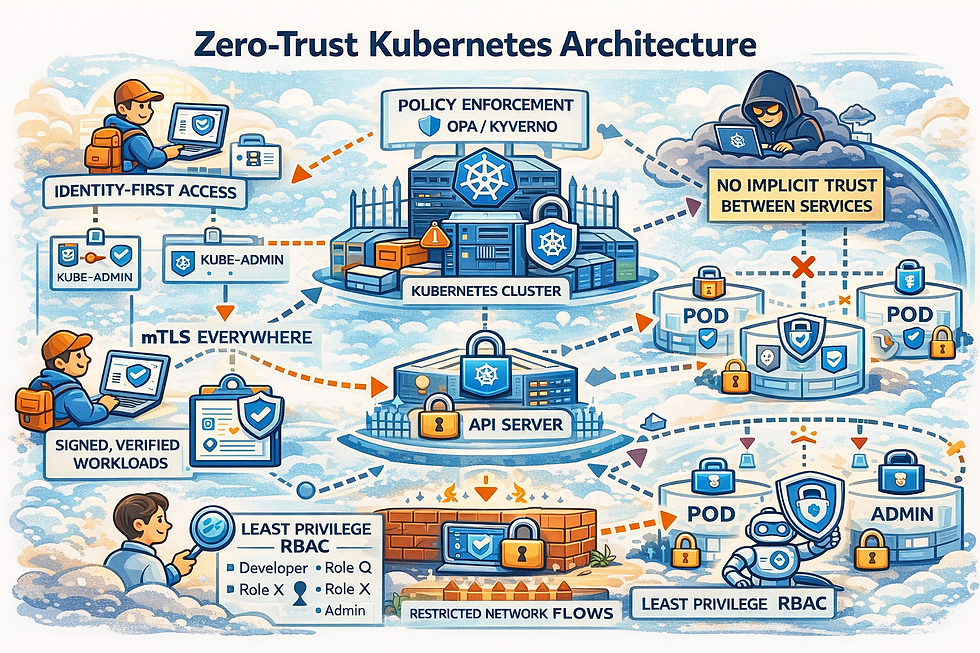
Traditional perimeter security is obsolete.
Clusters must defend themselves against:
internal misconfigurations
compromised supply chains
AI-driven attack automation
privilege misuse
invisible runtime anomalies
The future of Kubernetes security is:
autonomous
policy-driven
continuously verifiable
identity-centered
runtime enforced
Organizations must evolve to:
✔ Strict, identity-based access
✔ Immutable infrastructure workflows
✔ Signed images with full provenance
✔ AI-powered anomaly detection
✔ Kubernetes-native firewalls
✔ eBPF visibility and control
✔ GitOps pipelines that prevent configuration drift
✔ Runtime guards that enforce policy, not just alert on failures
Security is no longer a "product." It’s a continuous discipline embedded at every layer of the cluster.
Conclusion: Kubernetes Will Evolve. Threats Will Evolve Faster.
Kubernetes security in 2026 is:
more automated
more AI-driven
more observability-dependent
more policy-first
more deeply rooted in supply-chain trust
But attackers evolve at the same pace — sometimes faster.
Your clusters must be hardened not just against threats that exist today, but against threats that haven’t been invented yet.
Let Ananta Cloud Handle the Complexity — You Focus on Building
Kubernetes security shouldn’t slow you down. With Ananta Cloud, you get automated governance, secure-by-default workloads, continuous policy checks, and AI-powered anomaly detection — without additional ops burden.
✨ Try Ananta Cloud for your next Kubernetes project
✨ See how security becomes effortless
✨ Book a security assessment
Email: hello@anantacloud.com | LinkedIn: @anantacloud | Schedule Meeting


Comments