
Multi-Cloud vs Hybrid Cloud: Which Strategy Makes Sense for Your Business?

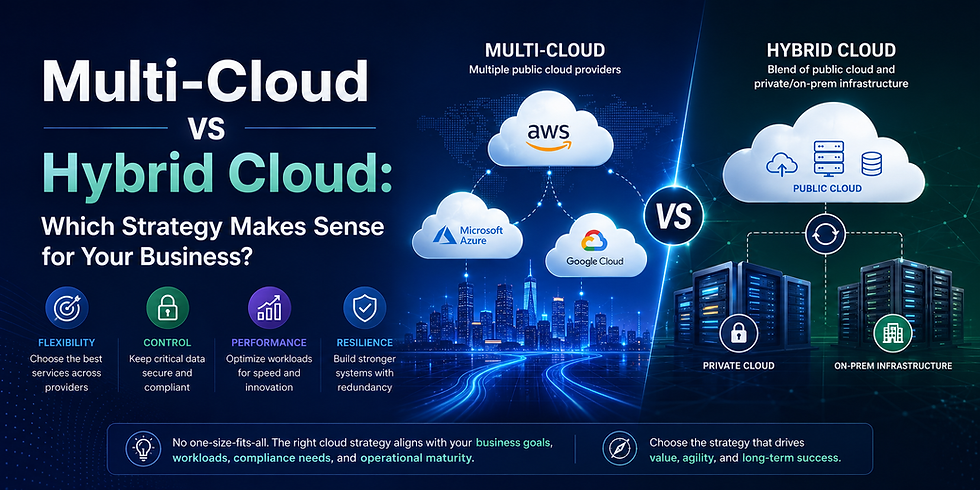
As businesses accelerate digital transformation, cloud strategy has become a boardroom decision, not just an IT conversation.
One of the most common questions enterprise leaders face is this:
Should we adopt a multi-cloud strategy or a hybrid cloud model?
At first glance, the terms are often used interchangeably. They are not the same.
Choosing the wrong approach can lead to higher operational complexity, increased costs, security blind spots, and slower innovation. Choosing the right one can improve agility, resilience, compliance, and business scalability.
This guide breaks down the differences between multi-cloud and hybrid cloud, where each model makes sense, and how to choose the right strategy for your organization.
What is Multi-Cloud?
A multi-cloud strategy means using cloud services from multiple public cloud providers.
For example:
AWS for application hosting
Microsoft Azure for analytics and enterprise workloads
Google Cloud for AI/ML capabilities
In this model, workloads may run independently across different cloud providers based on business needs.
Example
A SaaS company might use:
AWS for production applications
Google Cloud for machine learning pipelines
Azure for disaster recovery
The goal is flexibility, best-of-breed services, and reduced vendor dependency.
What is Hybrid Cloud?
A hybrid cloud strategy combines public cloud infrastructure with private cloud or on-premises environments.
This allows businesses to run workloads across both internal infrastructure and public cloud environments.
For example:
Sensitive customer data remains on private infrastructure
Customer-facing applications run on AWS
Backup systems run in Azure
The goal is balancing modernization with control.
Multi-Cloud vs Hybrid Cloud: Core Difference
The simplest distinction:
Multi-cloud = multiple cloud providers
Hybrid cloud = mix of cloud + private/on-prem infrastructure
A company can also have both.
For example:
On-prem ERP systems
AWS-hosted applications
Azure backup environment
That would be both hybrid and multi-cloud.
Multi-Cloud vs Hybrid Cloud Comparison

Factor | Multi-Cloud | Hybrid Cloud |
Infrastructure Model | Multiple public cloud providers | Public cloud + private/on-prem |
Vendor Dependency | Lower | Moderate |
Complexity | High | High |
Compliance Control | Moderate | Strong |
Legacy System Support | Limited | Excellent |
Flexibility | Very high | High |
Disaster Recovery | Strong | Strong |
Cost Optimization | Can be difficult | Depends on architecture |
AI/Advanced Services Access | Excellent | Depends on integration |
Migration Speed | Faster for cloud-native businesses | Better for phased modernization |
When Multi-Cloud Makes Sense
Multi-cloud is often the right choice when flexibility and specialization matter.
1. Avoiding Vendor Lock-In
Relying entirely on one cloud provider creates strategic dependency.
Risks include:
Pricing changes
Regional outages
Service limitations
Contract leverage issues
Multi-cloud reduces concentration risk.
2. Accessing Best-in-Class Services
Different providers excel in different areas.
Examples:
AWS → infrastructure maturity
Azure → Microsoft ecosystem integration
Google Cloud → AI and data analytics
Multi-cloud lets businesses choose the best tool for each use case.
3. Geographic or Regional Requirements
Some providers offer stronger regional infrastructure in specific markets.
This helps with:
latency optimization
regional resilience
data residency requirements
4. High Availability Strategy
Distributing workloads across providers reduces outage exposure.
If one provider has an incident, business continuity improves.
Multi-Cloud Challenges
Multi-cloud introduces operational complexity.
fragmented monitoring
inconsistent IAM policies
higher security management overhead
cross-cloud networking complexity
skill gaps across platforms
governance inconsistency
unpredictable costs
Without strong cloud governance, multi-cloud becomes expensive quickly.
When Hybrid Cloud Makes Sense
Hybrid cloud works well when business constraints require infrastructure flexibility.
1. Legacy Application Dependencies
Many enterprises still rely on:
ERP systems
internal databases
regulated applications
manufacturing systems
proprietary infrastructure
Hybrid allows modernization without forced replatforming.
2. Compliance and Data Sovereignty Requirements
Industries like:
healthcare
finance
government
manufacturing
often require tighter control over sensitive workloads.
Hybrid supports controlled placement.
3. Gradual Cloud Migration
A full cloud migration is not always practical.
Hybrid enables phased modernization:
move customer-facing apps first
migrate lower-risk workloads
modernize core systems over time
This reduces operational disruption.
4. Disaster Recovery and Business Continuity
Hybrid models can improve resilience.
Examples:
on-prem primary + cloud DR
cloud burst during peak demand
backup replication to public cloud
Hybrid Cloud Challenges
Hybrid cloud is not simple.
Challenges include:
integration complexity
networking dependencies
identity federation issues
security visibility gaps
infrastructure management overhead
performance bottlenecks
legacy compatibility constraints
Hybrid environments often become difficult to manage without automation.
Security Considerations
Security complexity increases in both models.
Multi-Cloud Security Risks
inconsistent IAM controls
duplicate security tooling
fragmented logging
misconfiguration risk
governance gaps
Hybrid Cloud Security Risks
weak network segmentation
inconsistent patching
on-prem/cloud identity issues
legacy vulnerabilities
visibility blind spots
Security architecture must be intentional from day one.
Cost Considerations
A common myth:
Multi-cloud automatically reduces costs.
Not necessarily.
Multi-cloud can increase spending through:
duplicate tooling
networking egress charges
multiple support contracts
skills overhead
governance inefficiency
Hybrid cloud costs depend heavily on infrastructure age and management overhead.
The right model depends on workload economics.
Decision Framework: Which Strategy Fits Your Business?
Choose Multi-Cloud if you:
✅ Want provider flexibility
✅ Need specialized cloud capabilities
✅ Are building cloud-native applications
✅ Want resilience across vendors
✅ Have mature cloud operations teams
Choose Hybrid Cloud if you:
✅ Have legacy infrastructure dependencies
✅ Need strong compliance control
✅ Prefer phased cloud migration
✅ Operate regulated workloads
✅ Need local infrastructure control
Choose Both if you:
✅ Run complex enterprise environments
✅ Need modernization + resilience + provider flexibility
Common Mistake Businesses Make
The biggest mistake is choosing architecture based on trends instead of business requirements.
Questions to ask:
What workloads are we running?
What compliance obligations exist?
What internal cloud expertise do we have?
What integration complexity can we manage?
Are we optimizing for speed, control, resilience, or innovation?
Architecture should follow business goals.
How Ananta Cloud Helps
Choosing between multi-cloud and hybrid cloud requires more than technical comparison.
It requires:
workload assessment
security evaluation
cost modeling
migration planning
governance design
operational readiness planning
At Ananta Cloud, we help organizations design practical cloud strategies aligned with business outcomes.
Our consulting services include:
cloud architecture assessments
multi-cloud strategy consulting
hybrid cloud modernization planning
migration roadmaps
cloud governance implementation
cloud security architecture
DevOps and automation enablement
cost optimization
Whether you are modernizing legacy systems or building cloud-native platforms, we help reduce risk and accelerate execution.
Final Thoughts
There is no universal winner in the multi-cloud vs hybrid cloud debate.
The right strategy depends on your:
business priorities
technical landscape
regulatory obligations
budget
operational maturity
The best cloud strategy is the one your business can manage securely, efficiently, and at scale.
Need help evaluating your cloud strategy? Connect with Ananta Cloud for a cloud architecture assessment and roadmap consultation.


Comments